
Reusable Medical Device Life Cycle Validation
Accelerate your reusable medical device validation with comprehensive lifecycle testing that compresses years into weeks. Get precise data on device durability, UDI compliance, and material integrity through controlled autoclave cycles - helping you predict service life, maintain regulatory compliance, reduce long-term costs, and validate performance across your device's entire service lifecycle.
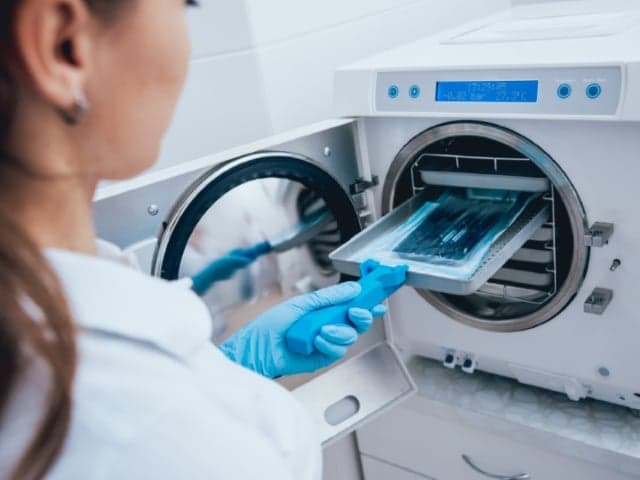
What is Reusable Medical Device Life Cycle Validation at Element?
Reusable medical device validation simulates the complete lifecycle of your devices through repeated autoclave sterilization cycles. At Element, we provide testing that evaluates dimensional stability, functionality, and material performance over accelerated aging periods, giving you actionable data about your device's longevity and compliance with UDI regulations.
What can Element offer you for reusable medical device life cycle validation?

Components and materials we test
Components and materials we test
From single components to complex assemblies, we validate medical instruments made from metals, polymers, and synthetic materials. Our expertise covers fixed and multi-component assemblies, including those with specialized features like joints, crevices, gaps, and lumens that require particular attention during sterilization cycles. We evaluate both new and existing devices, from simple single-piece instruments to complex articulating assemblies.
Key tests offered
Key tests offered
Our validation program covers dimensional stability assessment, functionality testing, materials degradation analysis, and UDI label durability verification. We provide corrosion and debris evaluation alongside proof testing against control instruments.
Key tests include:
- Identification Wear and Discoloration
- Materials Degradation or Performance
- Dimensional Inspection
- Functionality Testing
- Corrosion and Debris Generation
- Sample Autoclave Cycle Parameters
Key assessments include:
- Dimensional stability measurements
- Functionality articulation testing
- Materials degradation analysis
- UDI label durability verification
- Corrosion and debris evaluation
- Proof testing against control instruments
- Chemical analysis of debris
- Performance and appearance change tracking
Methods and solutions offered
Methods and solutions offered
Your devices undergo precise autoclave cycles at 270-273°F with exposure times of 4-15 minutes. We offer customizable testing parameters to match your specific requirements, , including optional pre/post-autoclave soaks.
Identification Wear and Discoloration:
Medical devices are required to have a Unique Device Identifier (UDI) for traceability. Repeated steam sterilization cycles can degrade or wear down the label. UDI regulations require that medical devices contain a unique device identifier on the device labels and packaging to trace the device from manufacturing through the end of its life cycle. Testing determines the lifespan of both the device and the label to ensure it remains legible.
Materials Degradation or Performance:
Materials like polymers, synthetics, and metals in reusable medical instruments are sensitive to moisture, heat, and pressure. These factors can cause degradation such as cracking, peeling, or unusual odors, compromising the instrument's performance and appearance. Testing identifies these issues to ensure safe usage and longevity.
Dimensional Inspection:
Instruments made from plastics and resins may experience dimensional changes due to thermal or residual stresses during use and sterilization. Dimensional inspection helps track and assess the stability of the instrument, particularly for features critical to implant sizing or function. This ensures the instruments maintain proper form throughout their lifecycle.
Functionality Testing:
For complex instruments, functionality testing simulates real-world use, checking components like rotation, threading, and locking mechanisms. Changes in wear, markings, debris, or functionality are monitored to ensure the device continues to work as intended throughout its lifecycle.
Corrosion and Debris Generation:
If an instrument fails functionality testing, investigation into wear or corrosion is necessary. This can include testing for metal debris or polymer cracking. Analyzing debris generation helps improve future designs and performance, addressing potential issues before they affect device functionality.
Sample Autoclave Cycle Parameters:
Autoclave parameters for aging testing simulate the sterilization process while accelerating material degradation. Pre and post-autoclave soaks, temperature control, and exposure time are carefully adjusted to track how the device and materials perform over time. Dimensional and imaging analysis can also be included to monitor the device’s progression throughout its life cycle.
Which labs offer this service
Which labs offer this service
Our team operates from Life Sciences hubs across the world, providing global access to our expert capabilities. Find your nearest Life Sciences hub on our Locations Page.
Specialized lifecycle analysis
Specialized lifecycle analysis
We perform comprehensive wear analysis and debris investigation throughout testing, with additional chemical and particle analysis capabilities to identify potential failure modes and improve future instrument performance. We also offer testing to failure options to determine maximum device capabilities. Our testing includes detailed imaging and dimensional analysis at consistent intervals using standardized equipment setups.
Components and materials we test
Medical instruments
- Single components/fixed assemblies
- Multi-component assemblies
- Complex devices with joints and crevices
- Devices with lumens
Materials
- Metals
- Polymers
- Synthetic materials
- Color-coded instruments
Your Challenges, Our Solutions
Accelerated validation through proven cycles
Durable identification throughout lifecycle
Complete performance verification
Precise lifecycle determination
Why Choose Element

Complete validation under one roof
Accelerated lifecycle insights
Global expertise at your service
Comprehensive performance analysis
Related services

Medical Device Testing Services
With Element as your medical device testing partner, you’ll enjoy the benefit of a single comprehensive supplier across feasibility, R&D and prototype trials, through product development, regulatory validation and production quality control.
Accelerated Aging Shelf Life Testing Services
Accelerated aging and shelf life testing predict product durability, reduce risk, and meet industry standards, providing data-driven insights for medical, packaging, and food sectors.
Frequently asked questions
What factors guide test sample selection?
Key considerations include material type (metal vs. nonmetal), component complexity, assembly type (single/multi-component), and overall geometry including joints and crevices.