
Hardness Testing Services
Trust Element’s experts to determine your materials’ ability to withstand other, harder materials. Element offers one of the most extensive ranges of hardness testing available – covering micro/macro hardness testing, in lab and field options plus all the choice techniques (Rockwell, Brinell, Bickers) alongside less common specialized testing like hot hardness testing. With precisely calibrated equipment and tailored solutions to meet a wide spectrum of standards.
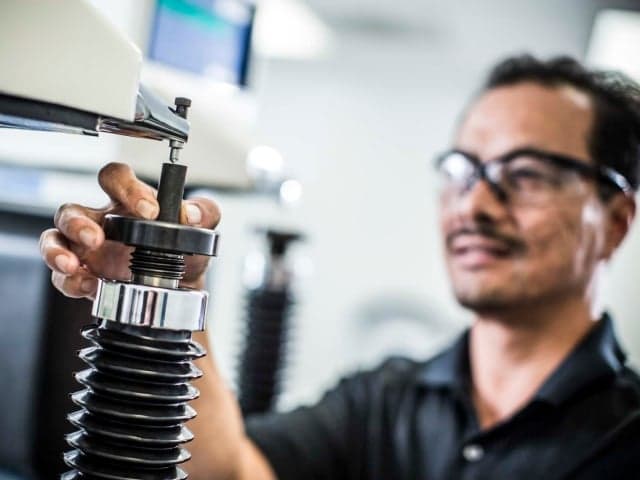
What is hardness testing at Element?
Hardness testing assesses how your material will resist force and penetration by other, harder materials, for example by scratching or denting. The results often correlate closely with tests into other crucial material properties, such as tensile strength. Used together, these tests help build a comprehensive picture of whether your material is robust enough to be widely adopted by engineers for materials selection, lot verification, and evaluating material processing. Hardness testing services offer a quick, efficient, and cost-effective method of evidencing the next steps in the development or manufacturing process.
What Can Element Offer You For Hardness Testing?
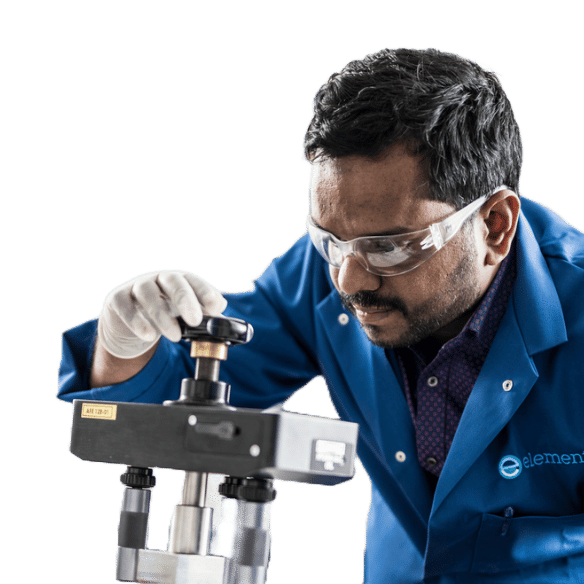
Key tests offered
Key tests offered
Our experts can advise on which hardness test is best for your specific requirements depending on your project goal – for example, if it requires material verification or further failure analysis.
- Vickers hardness test
- Knoop hardness test
- Shore hardness test
- Barcol hardness test
- VST hardness tests
We are able to offer both macrohardness testing (applied to loads of more than 1 kg) and microhardness testing (typically used for smaller or thinner samples and applied to loads of less than 1 kg) in accordance with a wide range of industry standards.
Materials we test
Materials we test
From critical metallic components to advanced polymers, we test virtually any material requiring hardness verification. Our capabilities extend to both metallic and non-metallic samples, including tool steels, complex alloys, valve seats, dies, and wear-resistant coatings designed for high-temperature applications where material integrity is paramount for operational safety and performance. We assess materials at various stages, from development through to failure analysis, helping you verify quality and troubleshoot potential issues before they impact your production.
- Ferrous and non-ferrous metals
- Tool steels and heat-treated alloys
- Valve seats and dies for high-temperature applications
- Advanced polymers and composite materials
- Welds, joints, and heat-affected zones
Methods and solutions offered
Methods and solutions offered
Our extensive range of solutions ensures you get the right test for your material and industry needs.
- Hot hardness testing for performance validation at extreme temperatures
- On-site hardness testing with Leeb, Rockwell C, UCI, and TIV methods for immovable equipment
- Predictive hardness testing to identify potential failures before they impact production
- Comprehensive material verification, ensuring compliance with industry standards
Cutting-edge equipment we use
Cutting-edge equipment we use
Our high-precision, calibrated equipment ensures reliable results across all hardness testing methods.
- Vacuum chambers for controlled high-temperature hardness testing
- Portable testing instruments for on-site Rockwell C, UCI, TIV, and Leeb testing
- Automated hardness testing systems for high-throughput material assessment
- Advanced microscopy and imaging for in-depth material structure analysis
Which labs offer this service
Which labs offer this service
Our team is truly global, operating from labs in more than 14 locations so you can benefit from our worldwide network and Element’s position as an established Testing, Inspection, and Certification market leader.
Few laboratories offer hot hardness testing at up to 1,600°F—we do. This advanced technique provides crucial data on tool steels, valve seats, and wear-resistant coatings, helping you select materials for high-temperature applications.
Standards we test to and materials we test
Element are able to test to a range of international standards, including but not limited to:
Airbus
- AITM 1-0058
American Petroleum Institute
- API Spec 5l, API STD 1104
American Society of Mechanical Engineers
- ASME Section IX
ASTM International
- ASTM A370, , ASTM A1038, ASTM B578, ASTM D785, ASTM D2240, ASTM D2583, ASTM D3363, ASTM E10, ASTM E18, ASTM E92, ASTM E140, ASTM E384
American Welding Society
- AWS B4.0
British Standards Institute
- BS 903-A57, BS EN ISO 6507, BS EN ISO 6508, EN ISO 6506, EN ISO 6508, BS EN ISO 14271
Deutsches Institut für Normung E.V.
- DIN 267-4, DIN 50103
Euronorm
- EN 1043-1, EN 1043-2, EN 10003-1, EN 10109
Ford Motor Company
- Ford ESS-M1A160-A
General Motors
- GM 500M (Sec. 5.1, 5.2), GM455M (Sec. 5.1)
International Organization for Standardization
- ISO 48, ISO 868, , ISO 1818, ISO 3738-1, ISO 4516, ISO 4545, ISO 6506, ISO 6507, ISO 6508, ISO 7619, ISO 9015, ISO 15156-1, ISO 15614-1, ISO 22826
Japanese Industrial Standard
- JIS B1052, JIS B1053
Military Specification
- MIL-STD-1312-6, MIL-STD-248D
Aerospace Industries Association/National Aerospace Standards Metric Standard
- NASM 1312
Naval Sea Systems Command
- NAVSEA S9074-GIB-010/248
SAE International
- SAE J78, SAE J417, SAE J429, SAE J995, SAE J1199
Metals and Alloys
- Tool steels
- Complex alloys
- Ferrous and non-ferrous metals
- Heat-treated materials
- Welds and joints
Polymers
- Advanced polymers
- Reinforced and non-reinforced rigid plastics
- Elastomers
Surface Treatments
- Wear-resistant coatings
- Surface hardened components
- Heat-affected zones
High-Temperature Components
- Valve seats
- Dies and tooling
- Materials for elevated temperature applications
Your Challenges, Our Solutions

Managing multiple materials can complicate testing
High-Temperature Performance Validation
On-Site Testing for Large Equipment
Ensuring Compliance with Industry Standards
Element Experts at your service


Why Choose Element
Utmost accuracy and precision
Solutions as diverse as your materials
Fast turnaround, efficient processes
Prevent failure before it occurs
Frequently asked questions
What is hot hardness testing?
Hot hardness testing measures material hardness while at elevated temperatures. Hot hardness can be valuable for assessing and comparing materials, such as tool steels and wear-resistant coatings, which are used in high-temperature applications such as valve seats and dyes. Element conducts hot testing similarly to normal Vickers hardness testing, except that the test is conducted inside a vacuum chamber which is capable of providing an elevated temperature of up to 1,600F.
How is hardness testing measured?
Hardness can be measured through various techniques, with surface hardness being the most common approach. This is achieved by evaluating the material's resistance to penetration or indentation on its outer layer. Additionally, hardness testing can provide insights into the material's intrinsic hardness, extending from "edge to core." This approach ensures a strong understanding of a material's structural integrity.
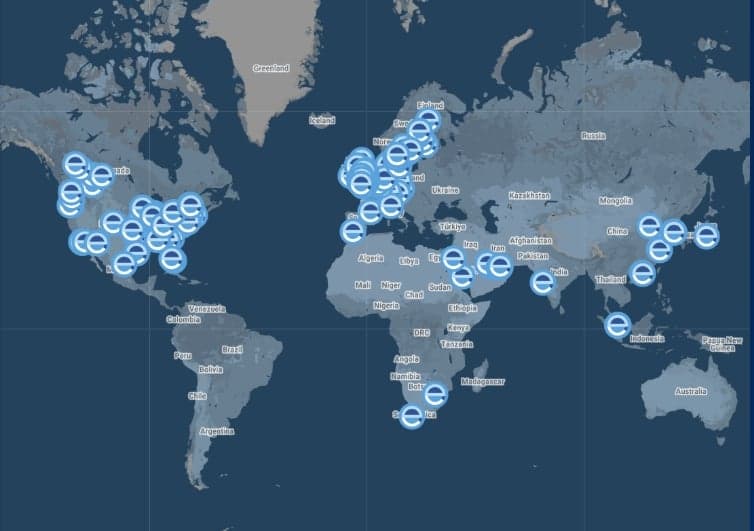
Explore our global network of labs and find your nearest location
VIEW ALL LOCATIONSRelated services
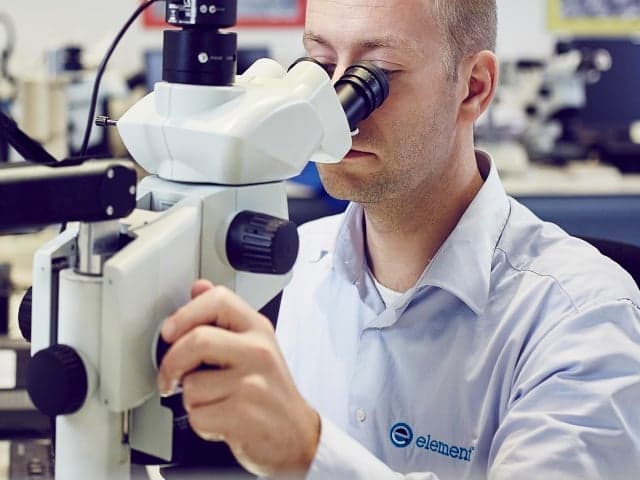
Metallurgical Testing Services
Expert metallurgical testing services to verify material integrity and prevent failures. Our accredited laboratories deliver precise analysis of metal microstructures, properties, and defects with expedited options. Ensure product reliability and compliance with industry standards.
Stress Rupture and Creep Testing
Element provides stress rupture and creep testing to evaluate material durability under prolonged stress and temperature. Our expert analysis supports manufacturers in preventing failures and ensuring long-term product performance.
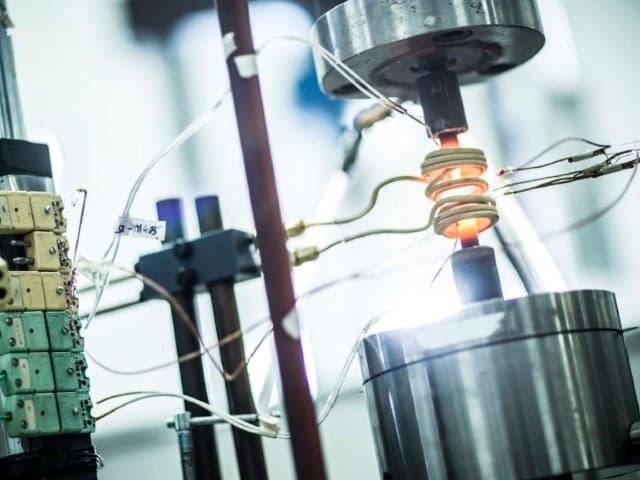
Fatigue Testing Services
Element's fatigue testing services analyze material durability under cyclic loads, providing insights into fatigue failure, fatigue life, and performance under real-world conditions.
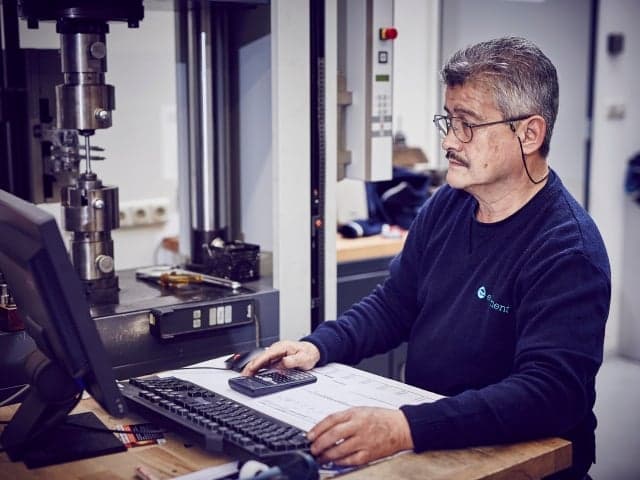
Tensile Testing
Element's tensile testing provides accurate data on material strength, stiffness, and durability. Browse our range of tensile testing services including Open Hole tensile testing.