
Choosing a Vibration Testing Procedure

This article, explains how to select a vibration-testing protocol for product qualification. It outlines sinusoidal, broadband random and composite procedures, highlighting how each method simulates real-world dynamic loads to optimise product reliability and safety.
From validating product design and establishing operational limits to qualifying equipment per customer or industrial standards, vibration testing is a valuable tool for manufacturers, designers, and engineers.
In general, vibration testing is used to demonstrate a product’s ability to resist dynamic loads without losing critical functional or structural integrity under specified loads. It can be used to identify accumulated stress effects, and the resulting mechanical weaknesses and performance flaws.
Choosing the right vibration testing protocol helps ensure that products can safely withstand the vibration levels they experience throughout their service life, ensuring product quality and safety. While most standards provide generic default test severities, more advanced procedures use existing data from product performance and operational environments to better replicate in-service conditions.
Understanding Different Vibration Testing Procedures
There is a wide range of vibration testing procedures available, each with unique features and benefits. While they all share similarities, the primary differentiating factor is the type of excitation created by each method. The pattern, rhythm, and dwell of vibration testing procedures help determine which method is best suited to replicate real-world conditions and ensure product quality.
Sinusoidal (Sine) Vibration
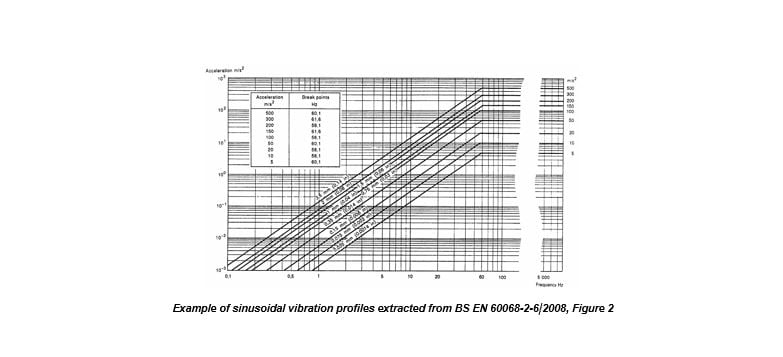
The simplest vibration testing procedure, sine vibration testing uses a single sinusoidal tone following simple harmonic motion input to the test specimen. This sinusoidal tone can be swept across the test frequency range, or it can be fixed on a single frequency, depending on the requirement.
Sinusoidal testing stimulates a test specimen’s natural structural (resonance) frequencies of vibration. Test frequency can be selectively varied to focus on natural frequencies of interest. Swept sinusoidal testing using lower acceleration levels is typically used to perform resonance searching (vibration response investigation) to identify resonance frequencies present in the test specimen.
In addition to identifying natural frequencies, swept sinusoidal vibration can be used to evaluate the endurance of test specimens over successive sweep cycles; this sweeping covers the entire test frequency range and accumulates oscillations at each frequency over the test duration.
Broadband Random
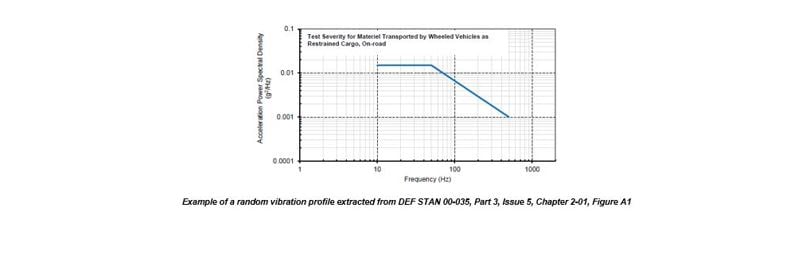
In contrast, random vibration procedures cover vibration of a stochastic nature resulting from transportation or operational environments (for example in aircraft, space vehicles, and land vehicles).
Random vibration replicates environments that are unpredictable and non-repetitive. Unlike sine methods, which rely on steady, regular frequency for testing, these methods use uniquely generated patterns to simulate real-world applications. When coupled with custom vibration profiles, random vibration testing protocols are a powerful tool for product qualification and validation.
Composite Vibration
For some projects, more than one type of vibration testing protocol is used to meet unique requirements, ensure accurate test conditions, or create accelerated programs. In these cases, multiple vibration methods are combined to create a single, composite standard.
While there are virtually endless numbers of unique composite vibration methods available, the most popular are sine-on-random and random-on-random.

Combined Environmental Test Procedures
Because environmental factors like temperature, humidity, and altitude can compound the effects of vibration on a product, combined environmental and vibration testing procedures are sometimes used to create a realistic test environment.
Popular in test programs like MIL-STD-810, RTCA DO-160, and DEF STAN 00-35, combined environmental programs provide a more robust validation program, allowing for real-world variables that affect product performance.
Element’s global product qualification labs offer vibration testing protocols and combined environmental programs using a wide range of electrodynamic vibration shaker systems. With experience in critical industries across the globe, we are experts at helping you create vibration testing procedures that make your products better, stronger, and more reliable.
For more information about our vibration testing services, or to request a quote, speak to an expert today.
Peer Reviewed By

Related Industries
Related Services
Vibration Testing Services
Ensure your product's safety and durability. Element's advanced vibration testing services replicate real-world scenarios, revealing potential issues before they occur. Learn More.
Aerospace RTCA DO-160 Testing
Element RTCA DO-160 Testing: Single-Source DO-160 Testing Performed In State-Of-The-Art Labs. Schedule Your Test Today.
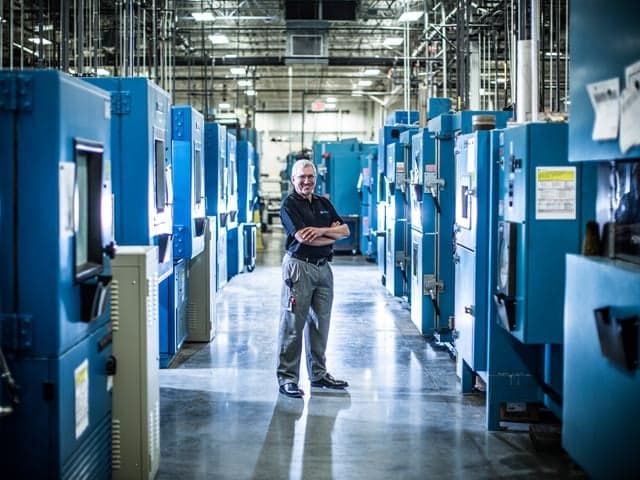
Climatic & Environmental Chamber Testing Services
Test your products' durability with environmental chambers at Element. Accurately simulate real-world conditions to meet industry standards and ensure performance.
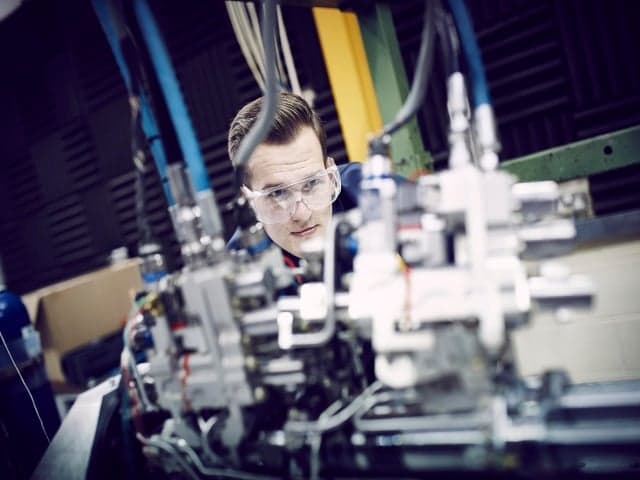
MIL-STD-810 Testing Services
Element's MIL-STD-810 testing services validate military and defense products under extreme conditions, delivering reliable, accredited results for compliance and performance qualification.